Vol. 1 No. 1 (2025): Decolonial Studies and Postcolonial Piety: Digital Islam, Education, Local Traditions, and Global Discourses
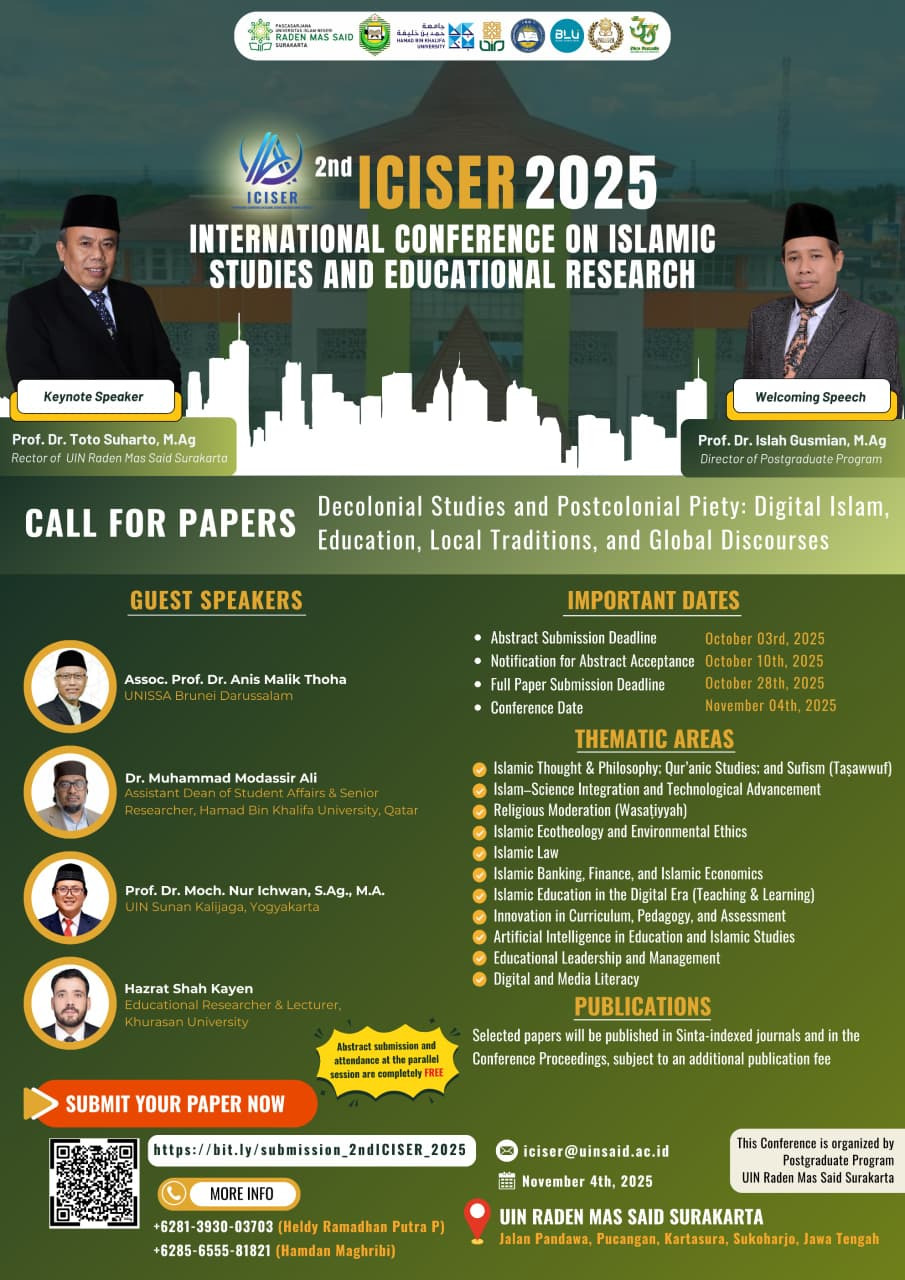
The ICISER 2025 proceedings emerge from a pressing scholarly concern: Islamic Studies and educational research can no longer be conducted through inherited center-periphery epistemologies that reproduce colonial bias in theory, method, and even in the metrics of what counts as progress. The conference theme Decolonial Studies and Postcolonial Piety: Digital Islam, Education, Local Traditions, and Global Discourses, treats decolonization not as a slogan but as an intellectual program: to interrogate dominant frameworks for interpreting Islam and education, and to reconstruct more just, context-sensitive, and analytically robust approaches suited to contemporary transformations.
On one hand, digitalization has generated a major reconfiguration of religious authority and pedagogy. Islamic learning and pious practice increasingly circulate through platforms, networks, and mediated publics, no longer confined to classrooms or formal institutions. On the other hand, postcolonial piety has taken diverse and sometimes contradictory forms. It can function as an emancipatory energy that reclaims local dignity and vernacular religious worlds; yet it can also become entangled in identity polarization, commodification, and intensified contestation in the politics of discourse. This volume gathers contributions that read these tensions with conceptual precision: how local traditions negotiate global discourses; how Digital Islam reshapes the ways believers learn, debate, and organize; and how Islamic education should respond to this new ecology without sacrificing scholarly depth or ethical integrity.
The first thematic cluster addresses Islamic thought and philosophy, Qur’anic studies, and Sufism (taṣawwuf). Contributions in this section do not merely map ideas; they re-examine epistemic instruments. They explore how Islamic philosophy and theology should be located within postcolonial intellectual landscapes; how Qur’anic studies can balance inherited exegetical traditions with contemporary hermeneutics and critical scholarship; and how Sufism is understood both as a spiritual discipline and as a living social practice; particularly in its entanglements with ethics, authority, and the formation of religious subjectivities in digital spaces.
A second cluster foregrounds Islam–science integration and technological advancement. Here, “integration” is not reduced to superficial scriptural endorsement of scientific claims; rather, it is approached as a methodological dialogue concerning conceptions of knowledge, causality, purpose, and public benefit (maṣlaḥah) in the Islamic intellectual tradition amid technological acceleration. This discussion intersects with the cluster on religious moderation (wasaṭiyyah), treated in this volume as an ethical–political framework for sustaining plural social life. Moderation is not framed as neutral “middle ground,” but as a principled stance that weighs social realities, the risks of extremism, structural injustice, and the need to cultivate a public sphere in which difference can be negotiated safely and productively.
The cluster on Islamic ecotheology and environmental ethics broadens the proceedings’ horizon. Climate disruption and ecological degradation demand renewed reflection on the human–nature relationship. Articles in this section examine theological and ethical foundations, concepts of trusteeship (amānah) and responsibility, and the possibility of ecological movements grounded in Islamic scholarly traditions while remaining in dialogue with science and policy. These concerns connect closely with Islamic law, where contributions demonstrate how fiqh and uṣūl al-fiqh engage contemporary problems—ranging from social governance and citizenship to emergent technologies. A recurring argument across these studies is that Islamic law is historically dialogical and context-attentive; it requires methodological rigor rather than ahistorical literalism.
The section on Islamic banking, finance, and economics highlights the interdependence of ethics, regulation, and innovation. In a digital and globalized economy, Islamic finance faces a dual challenge: sustaining normative commitments while responding to rapidly evolving systems, including financial literacy, product design, governance, and social impact. At the same time, education forms the backbone of this proceedings volume through sustained attention to Islamic education in the digital era, innovation in curriculum, pedagogy, and assessment, educational leadership and management, and digital and media literacy. Contributions here attend to institutional and classroom realities: shifting roles of teachers and lecturers, platform-mediated learning, equitable evaluation, and the ethical challenges of online education.
A culminating focus of the proceedings concerns artificial intelligence in education and Islamic Studies. AI introduces significant opportunities—personalized learning, educational analytics, research assistance, content enrichment, and accelerated academic workflows. Yet it also brings serious risks: algorithmic bias, concealed plagiarism, the erosion of epistemic authenticity, and privacy concerns, alongside new questions about authority and expertise. This volume therefore advances a critical posture: AI should be treated as a tool governed by ethics, methodology, and educational purpose—not as a substitute for scholarly reasoning.
Taken together, the ICISER 2025 proceedings present a layered research landscape: decolonial critique as a guiding orientation; postcolonial piety as a complex social reality; digital Islam as a new arena for knowledge production and religious practice; and education as a strategic site for shaping the future. The contributions assembled here aim not only to interpret contemporary change but also to refine the intellectual and ethical resources needed to live, learn, and practice religion responsibly amid rapid global transformations—especially where these transformations threaten justice, inclusivity, and the integrity of knowledge.